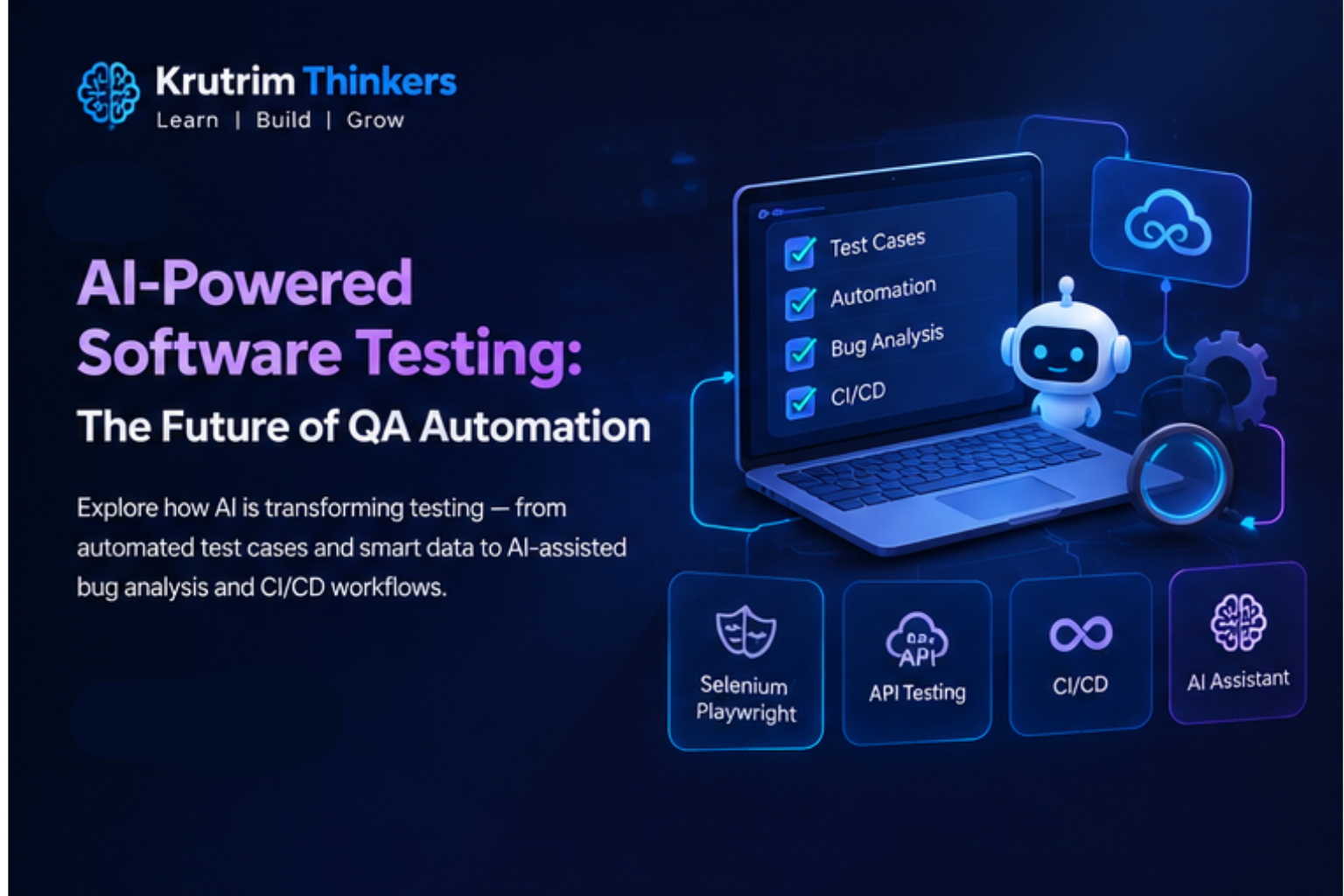
AI-Powered Software Testing: The Future of QA Automation
Software development is becoming faster, but faster development also creates a challenge: applications need to be tested quickly and reliably.
Traditional manual testing remains useful, but modern engineering teams increasingly combine automation, APIs, CI/CD pipelines, and AI-assisted testing.
This creates an important opportunity for QA professionals and developers: learning how AI can improve software testing workflows.
What Is QA Automation?
QA automation uses software tools to execute tests automatically.
Instead of manually repeating the same test every time an application changes, an automated test can perform the task repeatedly.
Common areas include:
- Functional testing
- API testing
- Regression testing
- Integration testing
- UI testing
- Performance testing
- End-to-end testing
Automation can make repetitive testing faster and easier to repeat.
Where Does AI Fit?
AI can complement traditional automation in several ways.
Test Case Generation
AI-assisted tools can help identify potential test scenarios from requirements, user stories, or application behavior.
For example, a login requirement may lead to test cases covering:
- Valid credentials
- Invalid credentials
- Missing fields
- Password recovery
- Account lockout
- Session behavior
The generated cases still need human review.
Intelligent Test Data
Testing often requires large amounts of input data.
AI-assisted approaches can help developers create varied datasets for testing different application conditions.
For example:
- Valid inputs
- Boundary values
- Invalid formats
- Unexpected combinations
- Large inputs
Visual Testing
Modern applications contain many visual elements.
Automated visual testing can compare screenshots and identify unexpected differences.
This can be useful for:
- Layout changes
- Broken components
- Responsive interfaces
- Missing elements
- Styling regressions
API Testing
APIs are at the center of modern applications.
A strong QA automation strategy should therefore include API testing.
Important areas include:
- HTTP status codes
- Request validation
- Authentication
- Authorization
- Response schemas
- Error handling
- Performance
Tools such as Postman, Playwright, REST clients and programming frameworks can be combined to create automated API test suites.
AI-Assisted Failure Analysis
One of the more interesting possibilities is using AI to analyze failed tests.
A test failure may produce:
- Logs
- Stack traces
- Screenshots
- Network responses
- Browser information
An AI system can help organize this information and suggest possible causes.
However, developers should treat AI-generated explanations as assistance rather than unquestionable conclusions.
CI/CD and Automated Testing
Testing becomes more valuable when connected to a CI/CD pipeline.
A typical workflow can look like:
Code Commit → Build → Automated Tests → Report → Deployment
This allows teams to detect regressions earlier in the development process.
Skills for an AI Testing Specialist
A modern QA professional can benefit from learning:
- Manual testing fundamentals
- Test case design
- JavaScript or Python
- API testing
- Playwright/Selenium
- SQL
- Git
- CI/CD
- Performance testing
- AI-assisted testing techniques
Understanding software development is also valuable because QA engineers increasingly work closely with developers and DevOps teams.
Build a Practical Testing Project
Instead of only learning individual tools, create an end-to-end project.
For example:
E-Commerce Testing Platform
Build automated tests for:
- User registration
- Login
- Product search
- Cart management
- Checkout
- API responses
- Payment validation
- Responsive UI
Then connect the test suite to a CI/CD workflow.
This gives you something concrete to demonstrate in a portfolio.
The Future of QA
AI is unlikely to remove the need for thoughtful software testing.
Instead, it can change where testers spend their time.
Repetitive activities can increasingly be automated, while human testers can focus on:
- Risk analysis
- Exploratory testing
- User experience
- Business requirements
- Edge cases
- Security considerations
- Test strategy
Krutrim Thinkers currently lists a QA Automation + AI Testing Specialist career program among its technology tracks.
Final Thoughts
The future of QA is not simply manual testing versus automation.
It is a combination of:
Testing fundamentals + Automation + Programming + CI/CD + AI-assisted workflows
For aspiring QA professionals, learning these skills together can create a more complete understanding of modern software quality.
The best place to start is with one application, one automated test, and one improvement at a time.