Generative AI vs Agentic AI: What's the Difference?
Artificial Intelligence has changed rapidly in recent years. Large language models made it possible for applications to generate text, code, images, summaries, and other forms of content.
Now another concept is gaining attention: Agentic AI.
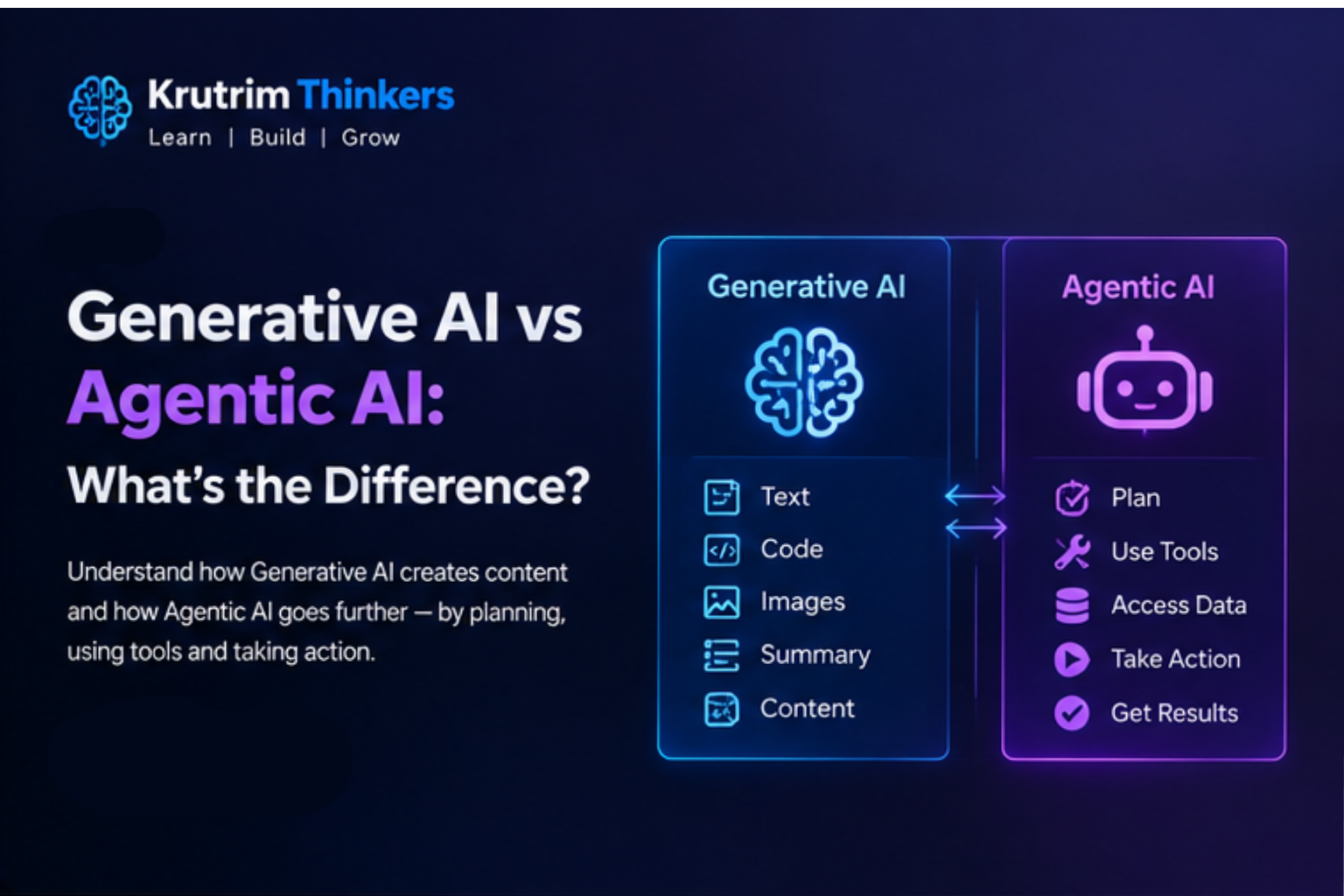
While Generative AI can create an answer or piece of content, Agentic AI focuses on systems that can work through a goal using models, tools, data, and workflows.
Understanding the difference is useful for anyone planning a career in modern AI development.
What Is Generative AI?
Generative AI refers to AI systems that can create new content based on learned patterns.
Examples include systems that generate:
- Text
- Code
- Images
- Summaries
- Marketing content
- Data analysis
- Conversational responses
Large language models are particularly useful for applications involving natural language.
For developers, however, simply connecting an application to an AI model is only the beginning.
What Is Agentic AI?
Agentic AI adds additional capabilities around an AI model.
An agent-based application may be designed to:
- Understand a goal
- Break the goal into tasks
- Select an appropriate tool
- Retrieve information
- Perform an action
- Evaluate the result
- Continue until the workflow is complete
For example, imagine a customer-support agent.
A traditional generative AI application might answer:
“Your order is currently being processed.”
An agentic system could potentially check an order-management API, identify the order status, determine whether an action is required, and initiate an approved workflow.
The important difference is the surrounding system architecture.
The Building Blocks of Agentic AI
Developers interested in agentic applications should understand several components.
Large Language Models
The model provides language understanding and generation capabilities.
Tools
Tools allow an AI system to interact with external services such as APIs, databases, search systems, or business applications.
Retrieval
Retrieval systems allow applications to obtain relevant information from documents or databases.
Memory and Context
Applications may need mechanisms for maintaining useful information throughout a workflow.
Workflows
Workflows define how different tasks and tools interact.
Evaluation
AI systems need testing and evaluation to determine whether their responses and actions are reliable.
Why Developers Should Learn Both
Generative AI and Agentic AI are not necessarily competing technologies.
An agentic application can use generative AI as one of its core components.
Generative AI teaches applications how to create and communicate.
Agentic AI expands that idea by connecting AI models with tools, data, and actions.
For aspiring developers, learning how these pieces work together can provide a strong foundation for building the next generation of AI applications.