Full-Stack AI Development: Why Modern Developers Need Both Web and AI Skills
AI is becoming part of the software stack rather than a separate technology.
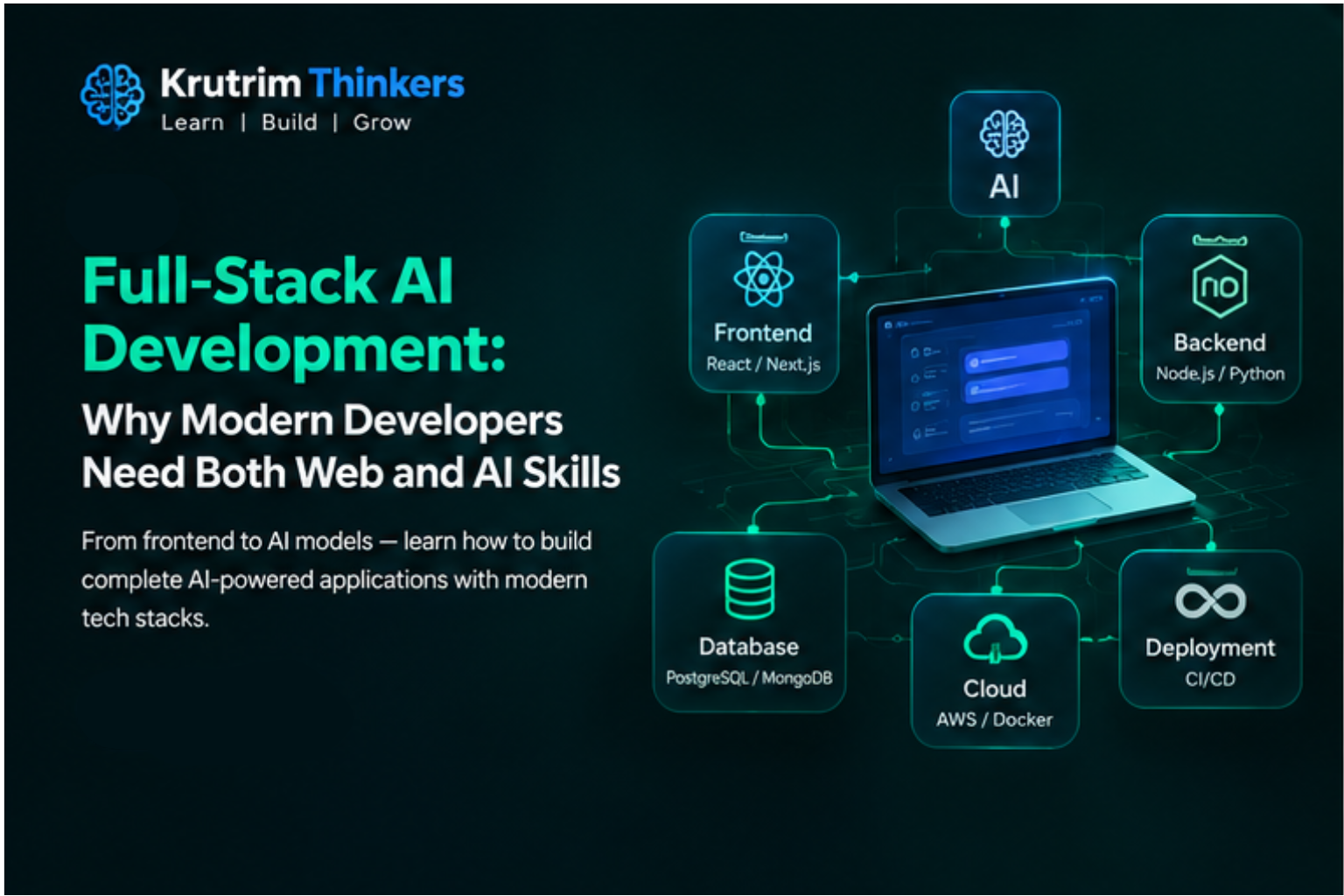
A modern application might include a React or Next.js interface, a backend API, a database, cloud infrastructure, and an AI model—all working together.
This is why Full-Stack AI development is becoming an important area for developers who want to build complete AI-powered products.
What Is Full-Stack AI?
Traditional full-stack development usually involves:
Frontend + Backend + Database + Deployment
Full-Stack AI adds another layer:
Frontend + Backend + Database + AI + Deployment
The developer needs to understand how these pieces communicate.
The Frontend
The frontend is where users interact with the application.
Popular technologies include:
- React
- Next.js
- TypeScript
- HTML
- CSS
- Tailwind CSS
For AI applications, the frontend might provide:
- Chat interfaces
- Form-based input
- AI dashboards
- Document upload
- Streaming responses
- Search interfaces
- Analytics
- Workflow controls
The Backend
The backend handles business logic and communication between the frontend, database, AI model, and external services.
Developers may work with technologies such as:
- Node.js
- Python
- FastAPI
- REST APIs
- Authentication
- Background jobs
A well-designed backend keeps the AI layer organized and secure.
Adding AI
The AI layer can provide functionality such as:
- Text generation
- Classification
- Summarization
- Semantic search
- Recommendations
- Document analysis
- AI assistants
For example, consider an educational application.
The frontend could allow a student to upload study material.
The backend could process the document.
The AI layer could create summaries and answer questions.
The database could store the student's history.
The result is a complete AI-powered product rather than a standalone AI demo.
Why APIs Matter
AI applications rarely operate in isolation.
They often communicate with:
- Databases
- Payment systems
- Authentication services
- Cloud platforms
- Search systems
- Third-party APIs
- Internal business tools
Understanding APIs therefore becomes an essential skill for Full-Stack AI developers.
Build Projects That Solve Problems
One of the most effective ways to learn Full-Stack AI is through projects.
Here are some examples.
AI Learning Platform
Build a platform where students can upload notes and ask questions about their study material.
Resume Analyzer
Create a system that analyzes resumes and compares them against a job description.
AI Customer Support Dashboard
Build a dashboard that combines conversations, customer information, analytics, and AI-generated responses.
Knowledge Management Platform
Create a searchable company knowledge base using document processing, embeddings and RAG.
Deployment Matters
A project running only on localhost is not the same as a production application.
Developers should learn:
- Docker
- Environment variables
- Cloud deployment
- Logging
- Monitoring
- Authentication
- API security
- Database management
These skills help turn a prototype into a usable application.
Why Next.js Is Useful
Next.js can provide a strong foundation for modern web applications because it brings frontend development together with server-side capabilities.
When combined with TypeScript and AI APIs, developers can create complete applications rather than isolated interfaces.
Krutrim Thinkers' published programs include Modern Full Stack AI with MERN/Next.js, AI-powered applications, cloud deployment and live projects.
The Full-Stack AI Mindset
The most useful question is no longer:
The most useful question is no longer:
“How do I use an AI model?”
Instead, ask:
“How can I build a complete product around AI?”
That shift encourages developers to think about users, interfaces, APIs, data, security, infrastructure, AI behavior and deployment together.
Final Thoughts
Full-Stack AI development combines two powerful areas:
Software engineering + Artificial Intelligence
Developers who understand both can build applications from the first screen all the way to the AI-powered backend.
Start small, build complete projects, deploy them, document the architecture, and keep improving.